


Is America’s Nurse Shortage Over?
Updated: Aug 2
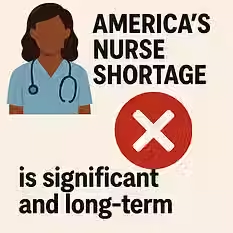
No — the U.S. nursing shortage is not over. The most recent data shows improvement in some areas, but the country is still facing a significant and long‑term shortage, with major variation by state and specialty. The continuation of a chronic nursing shortage, however, has provided vast opportunity for internationally trained nurses that they would not otherwise have had. A 2025 analysis found the U.S. is currently short about 295,800 registered nurses. This shortage is expected to persist through at least 2037, though it may gradually shrink from a 10% deficit in 2027 to 6% by 2037. The U.S. Bureau of Labor Statistics projects 193,000 RN job openings per year through 2032, driven by retirements and rising demand for care.
The shortage is perpetuated by an aging workforce. Nearly half of U.S. nurses are over 50 and approaching retirement. At the same time, there is growing patient demand: the aging population and chronic disease burden continues to increase care needs. The shortage is further exacerbated by education bottlenecks: over 65,000 qualified applicants were turned away from nursing programs in 2023 due to faculty shortages and limited clinical placements. Some states have surpluses, while others face severe shortages — the crisis is not evenly distributed. Some states are projected to have surpluses, while others will face deepening shortages through 2037. This uneven distribution means the national shortage persists even if certain regions improve. America’s nursing shortage is easing in some metrics, but it is far from over. The country is still in a long-term workforce crisis shaped by demographics, burnout, education constraints, and uneven distribution of nurses.
International nurses play an increasingly essential role in the U.S. healthcare system — and the latest data makes that clearer than ever. As of 2022, about 500,000 immigrant nurses were working in the U.S., representing 1 in 6 registered nurses. Hospitals are relying on them more each year: the share of hospitals hiring foreign‑educated RNs doubled from 16% in 2010 to 32% in 2022. These nurses often fill critical shortages in high‑need areas like rural hospitals, long‑term care, and high‑acuity units.
Despite their importance, international nurses face significant obstacles. The U.S. has paused processing new nurse visa applications since April 2023, with only older applications being processed. Proposed legislation to expand visas has stalled since 2023. These delays worsen the nursing shortage and leave hospitals unable to fill urgent vacancies.
International nurses must navigate U.S. licensure exams, English proficiency requirements, cultural and clinical orientation programs, and sometimes exploitative recruitment contracts. Scholars note concerns about brain drain from lower‑resource countries, fair treatment and support for internationally educated nurses, and the need for ethical recruitment standards and balanced migration policies.
International nurses are indispensable to the U.S. healthcare system. They fill critical workforce gaps, strengthen patient care, raise levels of cultural and linguistic diversity, and help stabilize hospitals facing chronic shortages. But visa backlogs, regulatory barriers, and ethical concerns continue to limit their ability to contribute fully. Research shows international nurses: maintain strong clinical performance, bring multilingual and multicultural strengths, and improve continuity of care in understaffed units. Hospitals with chronic vacancies increasingly depend on internationally educated nurses (IENs).
Fair treatment and support for internationally educated nurses are both critically important along with the need for ethical recruitment standards and balanced migration policies. Hospitals with chronic vacancies increasingly depend on internationally educated nurses (IENs). Between 2010 and 2022, the share of hospitals hiring more IENs year‑over‑year rose from 2% to 14%. Despite their importance, international nurses face significant obstacles. International nurse recruitment is a multi‑step pipeline that connects foreign‑educated nurses with U.S. healthcare employers — and it’s more structured (and regulated) than many people realize. The process involves licensure, credentialing, immigration, and placement, and each step has its own requirements. International nurses must complete eight major steps before they can legally work as Registered Nurses (RNs) in the United States.
Recruitment usually begins with a U.S. hospital, a direct‑hire recruitment agency, or a staffing agency that sponsors visas. The first required step for immigration processing is to pass the NCLEX‑RN exam. Every international nurse must pass the NCLEX‑RN, the U.S. licensure exam. Agencies often provide preparation support. Nurses must have their education and training evaluated by an approved body such as CGFNS. This confirms their training is equivalent to U.S. RN standards. They must obtain VisaScreen Certification verifying Nursing credentials, English proficiency, and licensure validity all of which is required by U.S. immigration law before any work visa can be issued.
Employers often provide relocation assistance, housing support, and cultural and clinical orientation programs. This step is enormously helpful for nurses in the transition into U.S. healthcare systems. The next step is to begin employment. After arrival, nurses start working in hospitals, clinics, or long‑term care facilities. Demand is especially high due to the ongoing U.S. nursing shortage.
The U.S. vigorously recruits international nurses because of the aging U.S. population, retiring domestic nurses, post‑pandemic burnout, and the expansion of healthcare services. Demand is especially high in specialties like ICU, ER, and neonatal care. International recruitment is not always smooth, especially because of visa backlogs, long processing times, exploitative or restrictive contracts, cultural and clinical adjustment, and English proficiency requirements. Understanding these early on helps nurses avoid scams and predatory agencies.
Is America’s Nurse Shortage Over?



This statement is a powerful and timely affirmation of both the urgency and the opportunity embedded within America’s ongoing nursing shortage. It does not shy away from the reality: the shortage is significant, long-term, and unevenly distributed across states and specialties. Yet it also illuminates a vital and hopeful dimension — the indispensable role of internationally trained nurses in sustaining and strengthening the U.S. healthcare system.
What makes this piece compelling is its clarity and balance. It presents hard data — nearly 296,000 nurses short, with projections extending to 2037 — while also acknowledging the systemic forces behind the crisis: an aging workforce, rising patient demand, and educational bottlenecks. These facts are not just statistics; they are the scaffolding of…